
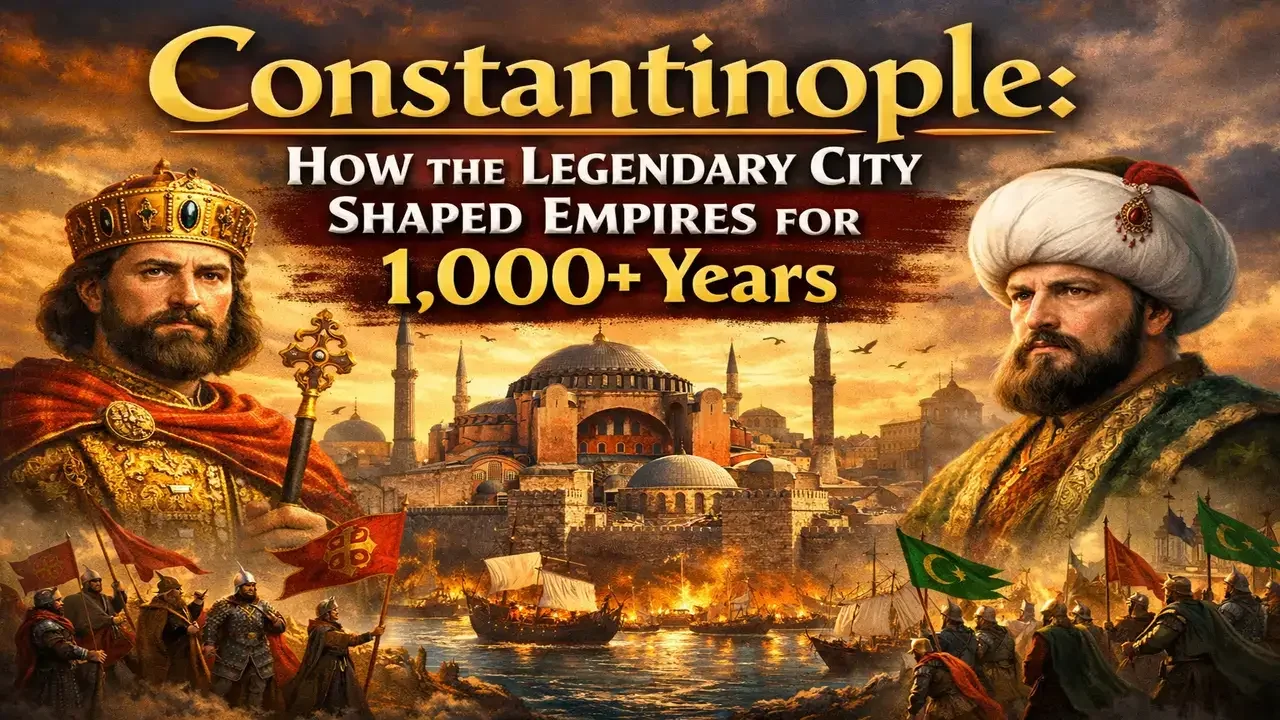
Constantinople was the capital of the Eastern Roman (Byzantine) Empire for over 1,100 years. Founded by Emperor Constantine I in 330 AD on the site of ancient Byzantium, the city controlled the strategic Bosphorus Strait and served as a crossroads between Europe and Asia until its conquest by the Ottomans in 1453.
Table of Contents
ToggleWhy Constantinople Still Matters
Some cities belong to a single era. Constantinople belonged to all of them.
For more than a millennium, it was the largest, wealthiest, and most strategically vital city in the Western world. It outlived the Roman Empire that built it. It survived dozens of sieges. It shaped Christianity, influenced Islamic architecture, and defined medieval geopolitics in ways that still echo through modern borders. When it finally fell on a spring morning in 1453, the shockwaves reached every court in Europe within weeks.
Yet most people today know surprisingly little about what made Constantinople extraordinary — beyond the fact that it eventually became Istanbul. The real story is far stranger, more dramatic, and more layered than any summary can capture.
From Byzantium to Nova Roma
The city’s origins long predate the Roman Empire. Greek colonists from Megara founded a settlement called Byzantium around 657 BC, choosing a rocky peninsula where the Golden Horn inlet meets the Bosphorus — a narrow waterway separating Europe from Asia Minor. It was a fisherman’s paradise and a trader’s dream. Whoever controlled this point controlled the only sea route between the Mediterranean and the Black Sea.
For centuries, Byzantium remained a modest but strategically useful city, passing between Greek, Persian, and eventually Roman hands. It was Emperor Constantine I who transformed it entirely. In 324 AD, after defeating his rival Licinius in battle nearby, Constantine chose Byzantium as the site for a grand new capital. He expanded the city dramatically, built monumental forums and palaces, and inaugurated it on May 11, 330 AD as Nova Roma — New Rome.
The name never stuck with ordinary people. They called it Constantinople, the city of Constantine. And so it remained.
The Walls That Defied the World
No discussion of Constantinople makes sense without understanding its defenses. The city was, in military terms, a nightmare to attack.
On three sides, water protected it — the Sea of Marmara to the south, the Bosphorus to the east, and the Golden Horn to the north. A massive chain could be stretched across the Golden Horn’s entrance, blocking enemy fleets entirely.
The land approach from the west was guarded by the legendary Theodosian Walls, constructed under Emperor Theodosius II in the early 5th century. These weren’t just walls — they were a layered defensive system: a deep moat, an outer wall, a killing ground, and then the towering inner wall studded with nearly 100 towers. For a thousand years, no army breached them by force alone.
This is a fact worth pausing on. A thousand years. No other fortification in history held that record.
A City of Faith and Spectacle
Constantinople wasn’t just a fortress. It was a cultural capital of staggering ambition.
Hagia Sophia
Emperor Justinian I commissioned the Hagia Sophia in 532 AD, and it was completed in just five years — an engineering marvel whose massive dome seemed to float on light. For nearly a millennium, it was the largest cathedral in the world. When Justinian first entered the finished building, he reportedly whispered, “Solomon, I have surpassed thee.” Whether he actually said it or not, the sentiment was accurate.
The Hippodrome
The Hippodrome was the city’s beating social heart — a chariot-racing stadium that seated roughly 100,000 spectators. It was also politically dangerous. The Nika Riots of 532 AD, which began as a dispute between racing factions, nearly toppled Justinian’s government and left much of the city in ashes. The emperor considered fleeing. It was Empress Theodora who reportedly shamed him into staying, declaring she would rather die in imperial purple than run.
Libraries, Trade, and Scholarship
Constantinople preserved vast quantities of Greek and Roman knowledge that would have otherwise been lost. Its libraries, monasteries, and scriptoria kept classical texts alive through the centuries when Western Europe had largely forgotten them. Scholars fleeing the city after 1453 carried manuscripts to Italy, directly fueling the Renaissance.
The city was also one of the medieval world’s great commercial hubs. Silk, spices, grain, gold, and enslaved people moved through its markets. Venetian and Genoese merchants maintained entire trading quarters within the city — a privilege they sometimes exploited and Constantinople sometimes regretted.
The Sieges: A City Under Constant Pressure
Constantinople’s strategic value made it a perpetual target.
- 674–678 AD — The Umayyad Caliphate besieged the city for four years. Byzantine defenders used Greek fire, a mysterious incendiary weapon, to destroy the Arab fleet. The recipe was a closely guarded state secret and remains unknown today.
- 717–718 AD — A second major Arab siege failed, partly due to a brutal winter and Bulgarian reinforcements.
- 860 AD — A Rus’ fleet (Viking-descended warriors from modern Ukraine and Russia) attacked the city, shocking its inhabitants.
- 1204 AD — The most devastating blow before the final fall. Soldiers of the Fourth Crusade, supposedly bound for the Holy Land, sacked Constantinople instead. They looted churches, destroyed priceless artifacts, and established a short-lived Latin Empire. The Byzantine state fractured and never fully recovered. This event, more than any other, weakened the empire beyond repair.
The Ottoman Rise and the Road to 1453
By the 14th century, the Byzantine Empire had shrunk to a shadow of itself — little more than Constantinople and a few scattered territories. Meanwhile, a new power was rising in Anatolia.
The early Ottoman beylik, established by Osman I in the late 1200s, expanded steadily under his successors. His son Orhan Gazi captured Bursa in 1326, making it the first major Ottoman capital, and later took Nicaea (modern İznik) and crossed into Europe. These early campaigns laid the groundwork for everything that followed.
By the time Sultan Mehmed II turned his attention to Constantinople in 1453, the Ottomans already controlled virtually everything around it. The city was an island in an Ottoman sea.
The Fall: May 29, 1453
Mehmed II, just 21 years old, assembled an army of roughly 80,000 troops and a fleet of over 120 ships. He also brought something unprecedented: massive cannons, including the enormous bombard cast by a Hungarian engineer named Orban, capable of hurling stone balls weighing over half a ton.
The Byzantine emperor, Constantine XI Palaiologos, had fewer than 10,000 defenders — including a contingent of Genoese soldiers under Giovanni Giustiniani.
The siege lasted 53 days. Ottoman engineers dragged ships overland on greased logs to bypass the chain across the Golden Horn. The great cannons slowly crumbled sections of the Theodosian Walls. On the morning of May 29, Ottoman forces broke through.
Constantine XI died fighting, reportedly charging into the final melee. His body was never conclusively identified.
Mehmed entered the city, rode to the Hagia Sophia, and ordered it converted into a mosque. Constantinople became Istanbul — though the name change was gradual, not instantaneous.
Legacy That Refuses to Fade
Constantinople’s fall didn’t erase its influence. Ottoman Istanbul inherited its architecture, its administrative traditions, and its position as a bridge between continents. The Hagia Sophia’s dome inspired the design of every great Ottoman mosque that followed. European scholars, shaken by the fall, accelerated exploration westward — some historians draw a direct line from 1453 to Columbus’s voyage in 1492.
The city’s story is also a reminder that no power is permanent. Rome thought itself eternal. Byzantium thought its walls were unbreakable. The Ottomans who conquered it would eventually face their own reckoning.
Key Facts at a Glance
| Detail | Information |
|---|---|
| Founded as Byzantium | c. 657 BC |
| Refounded by Constantine I | 330 AD |
| Theodosian Walls built | 408–413 AD |
| Hagia Sophia completed | 537 AD |
| Sacked by Fourth Crusade | 1204 AD |
| Fell to Ottoman forces | May 29, 1453 |
| Renamed Istanbul (officially) | 1930 (Turkish Postal Law) |
Frequently Asked Questions
Why was Constantinople so difficult to conquer?
Its peninsula location meant attackers could only approach by land from one direction — the west — where the massive Theodosian Walls created a triple-layered defense. The Golden Horn chain blocked naval assaults, and the surrounding waters provided natural protection on three sides.
Did Constantinople really become Istanbul overnight?
No. The name “Istanbul” likely derives from the Greek phrase eis tin polin (“into the city”) and was used informally for centuries. The Ottoman government continued using “Konstantiniyye” in official documents well into the 19th century. Turkey officially adopted “Istanbul” in 1930.
What happened to the Hagia Sophia after the Ottoman conquest?
Mehmed II converted it into a mosque immediately after the conquest. It served as a mosque until 1934, when Mustafa Kemal Atatürk turned it into a museum. In 2020, Turkey reconverted it into a functioning mosque, a decision that sparked international debate.
How did the fall of Constantinople affect Europe?
It sent shockwaves across the continent, ending any remaining hope of reclaiming the eastern Mediterranean. Greek scholars fleeing westward brought classical texts that helped ignite the Renaissance. It also disrupted traditional trade routes, motivating the Age of Exploration.