
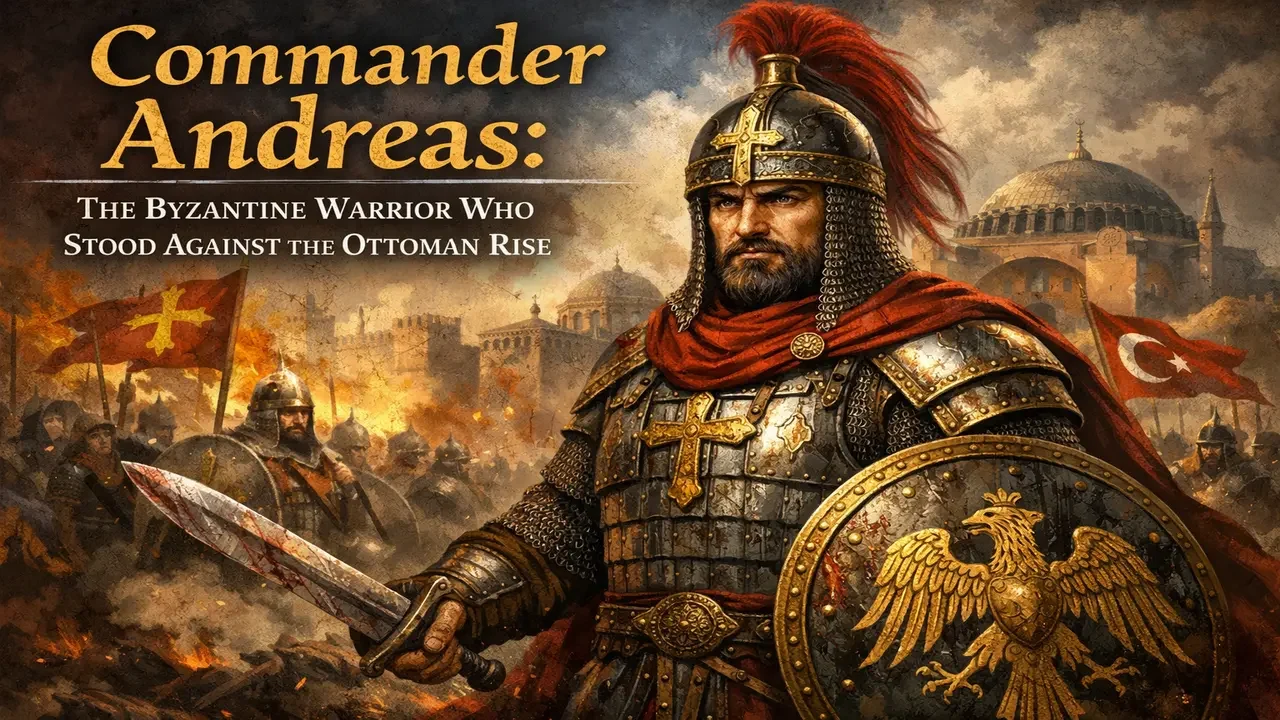
There are villains you forget the moment a scene ends. Then there are antagonists who grip you so tightly that you find yourself quietly respecting them — even while rooting for the other side. Commander Andreas, the formidable Byzantine military leader featured in the hit Turkish historical drama Kuruluş Orhan, is exactly that kind of character.
Table of Contents
ToggleHe represents something far bigger than a single man on horseback. He embodies the last desperate breath of a crumbling empire. He carries the weight of Byzantine pride, Roman military tradition, and the stubborn refusal to accept that the world is changing beneath his feet.
Whether you encountered him first through the television screen or stumbled across his name while researching early Ottoman-Byzantine conflicts, Commander Andreas is a figure worth understanding deeply. His story — rooted in both historical reality and dramatic storytelling — reveals the brutal, fascinating dynamics of 14th-century Anatolia.
Who Was Commander Andreas?
To understand Commander Andreas, you first need to understand the world he inhabited.
During the late 13th and early 14th centuries, the Byzantine Empire was in severe decline. Once the most powerful state in the Mediterranean, it had been weakened by internal power struggles, the catastrophic Fourth Crusade of 1204, and the relentless pressure of Turkic tribes pushing westward across Anatolia.
The frontier zones of northwestern Anatolia — particularly the regions around Bursa, Bilecik, İnegöl, and Gemlik — became contested borderlands. Byzantine fortresses dotted the landscape, each one commanded by a military governor or tekfur (the Turkish term for a Byzantine lord or commander). These men were responsible for holding the line against the expanding Ottoman beylik.
The Role of Byzantine Frontier Commanders
Commanders like Andreas served as the empire’s last shield in Anatolia. They controlled fortified towns, maintained garrisons of professional soldiers, and forged alliances — sometimes with other Byzantine lords, sometimes with rival Turkish tribes — to resist Ottoman encroachment.
These were not pampered palace generals. Frontier commanders lived hard, fought constantly, and operated with significant autonomy from Constantinople. Many of them were shrewd political operators who understood that survival required more than just swords. It required diplomacy, deception, and occasionally betrayal.
Commander Andreas, as portrayed in the Kuruluş Orhan series, captures this reality with striking authenticity.
Commander Andreas in Kuruluş Orhan: A Character Study
The Kuruluş Orhan Series with English Subtitles on KurulusOrhan.io has introduced international audiences to a richly detailed version of Commander Andreas that goes far beyond the typical “foreign villain” archetype common in historical dramas.
A Warrior With Conviction
What makes Andreas compelling is that he genuinely believes he is fighting for the right cause. He does not see himself as an oppressor or a tyrant. From his perspective, he is defending centuries of civilization, order, and Christian heritage against what he views as an existential threat.
This moral complexity elevates the entire series. When Andreas clashes with Orhan Gazi on the battlefield or across a negotiating table, the tension does not come from simple good-versus-evil dynamics. It comes from two deeply committed men who each believe history is on their side.
Military Brilliance and Strategic Thinking
Andreas is not a brute who charges blindly into battle. The series portrays him as a calculating strategist — someone who studies his enemy, exploits weaknesses, and understands the value of patience. He forms alliances with other tekfurs, coordinates ambushes, and uses intelligence networks to stay ahead of Ottoman movements.
This mirrors historical accounts of Byzantine frontier warfare, where commanders relied heavily on defensive strategy, fortification, and coalition-building rather than direct large-scale confrontation. The Byzantine military tradition, inherited from Rome, emphasized discipline and tactical flexibility — traits that Andreas displays throughout the series.
The Human Side of the Enemy
One of the most striking choices the writers made was to give Andreas genuine emotional depth. He is not a cardboard cutout antagonist. Viewers see his loyalty to his people, his burden of command, and moments where his resolve cracks under the weight of inevitable defeat.
This layered portrayal has earned praise from audiences worldwide. On forums dedicated to the Kuruluş Orhan Series on KurulusOrhan.io, fans frequently discuss Andreas as one of the most well-written characters in the show — a testament to both the scriptwriters and the actor’s performance.
The Byzantine-Ottoman Conflict: Why It Matters
The clash between figures like Commander Andreas and Orhan Gazi was not a minor border skirmish. It was a civilizational turning point that shaped the next six centuries of world history.
From Frontier Beylik to Empire
When Osman Gazi founded the Ottoman principality in the late 1200s, it was one of many small Turkic beyliks competing for territory in Anatolia. What made the Ottomans different was their position on the Byzantine frontier. Every fortress they captured, every tekfur they defeated, brought them closer to the richest prize in the region — the city of Bursa.
Orhan Gazi’s conquest of Bursa in 1326 transformed the Ottomans from a tribal confederacy into a genuine state. And every step toward that conquest involved confronting Byzantine commanders who, like Andreas, fought tenaciously to preserve their world.
The Fall of the Frontier Fortresses
Historical sources describe a pattern that repeated itself across dozens of fortress towns during this period. Ottoman forces would besiege a fortified position, cut off supply lines, and apply sustained pressure over weeks or months. Some commanders surrendered and were treated with relative mercy. Others fought to the end.
The series captures this grinding, methodical style of conquest with impressive detail. Commander Andreas represents the commanders who chose resistance — those who staked everything on holding their ground, even as the world shifted irreversibly around them.
Why Audiences Connect With Commander Andreas
In a television landscape crowded with one-dimensional villains, Andreas stands apart. International viewers, particularly those watching with English subtitles on KurulusOrhan.io, have responded to the character with remarkable enthusiasm.
Complexity Over Caricature
Modern audiences crave nuance. They want antagonists who feel real, whose motivations make sense from their own perspective. Commander Andreas delivers exactly that. His opposition to Orhan Gazi is not rooted in personal hatred. It is rooted in duty, honor, and a genuine desire to protect his people.
This approach aligns with a broader trend in Turkish historical drama. Shows like Diriliş: Ertuğrul and Kuruluş: Osman have progressively developed more complex portrayals of Byzantine, Mongol, and Crusader characters. Kuruluş Orhan takes this evolution further with Andreas.
A Mirror for the Hero
Great antagonists serve as mirrors for the protagonist. Andreas forces Orhan Gazi to sharpen his strategy, question his assumptions, and prove that his vision for a new state is worth the blood it costs. Without a worthy opponent, Orhan’s victories would feel hollow. Andreas gives those victories weight and meaning.
How Close Is the Series to Reality?
Turkish historical dramas take creative liberties — that is expected and understood. However, Kuruluş Orhan grounds its storytelling in genuine historical frameworks.
The existence of Byzantine military commanders defending frontier fortresses against Ottoman expansion is thoroughly documented. Historians like Halil İnalcık, widely regarded as the foremost authority on early Ottoman history, described the frontier zone as a fluid, violent, and deeply complex environment where Turkish and Byzantine cultures often intermingled even as they fought.
While the specific name “Andreas” may be a dramatic creation, the type of figure he represents is entirely historical. Dozens of commanders just like him held fortress towns across Bithynia, and their resistance shaped the pace and direction of Ottoman expansion.
Professor İnalcık wrote: “The Ottoman frontier was not a simple line of conquest. It was a world of constant negotiation, conflict, and adaptation — on both sides.”
Commander Andreas brings that world to life in a way that textbooks rarely can.
Where to Watch Commander Andreas in Action
For those who want to experience the full arc of Commander Andreas’s story, the best resource available is the Kuruluş Orhan English Subtitles on KurulusOrhan.io. The platform offers high-quality episodes with accurate subtitles, making the series accessible to English-speaking audiences worldwide.
Whether you are a longtime fan of Turkish historical drama or a newcomer drawn by curiosity about Byzantine-Ottoman history, the series — and the character of Andreas in particular — offers hours of gripping, thoughtful entertainment.
Final Thoughts
Commander Andreas is more than a television character. He is a window into one of history’s most consequential transitions — the moment when the Byzantine world began to give way to the Ottoman. His intelligence, his courage, and his ultimate tragedy make him one of the most memorable figures in modern historical drama.
The best stories are not about heroes defeating faceless enemies. They are about worthy opponents who force each other to become something greater. In Kuruluş Orhan, Commander Andreas fulfills that role with power and dignity.
Start watching his story today on KurulusOrhan.io and discover why millions of viewers around the world are captivated by this extraordinary series.