
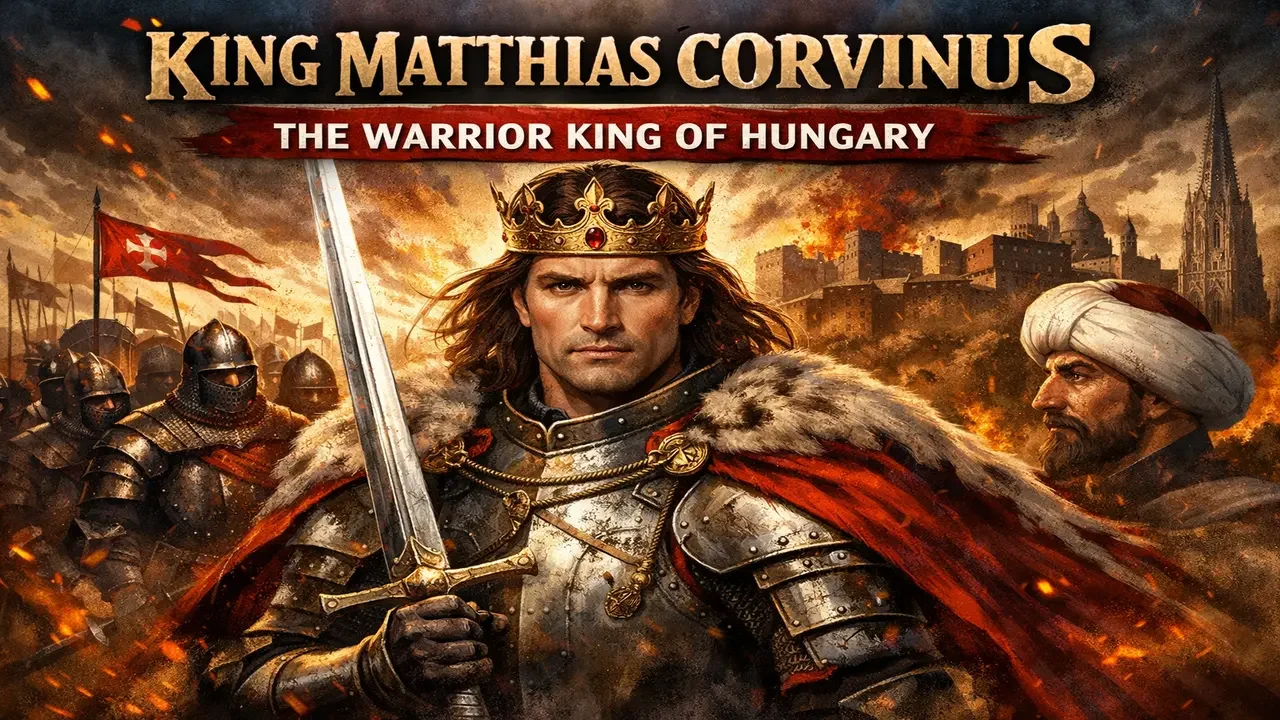
King Matthias Corvinus was the powerful ruler of Hungary from 1458 to 1490, known for building the Black Army, strengthening royal authority, and resisting Ottoman expansion. His reign marked a golden age of culture, military reform, and political stability in Central Europe.
Table of Contents
ToggleWho Was King Matthias Corvinus?
King Matthias Corvinus stands among the most remarkable rulers of medieval Europe. Born in 1443, he became King of Hungary at just 14 years old.
His full name, Matthias Corvinus, reflects both heritage and ambition. “Corvinus” comes from the Latin word corvus (raven), a symbol tied to his family identity.
But Matthias was not just a king by title.
He was a strategist, reformer, and one of the first rulers to modernize warfare in Europe.
Early Life and Rise to Power
A Royal Path Shaped by Conflict
Matthias was the son of John Hunyadi, a respected military leader who defended Hungary against Ottoman expansion.
After his father’s death, Hungary entered political instability.
At just 14 years old, Matthias was unexpectedly elected king in 1458.
This was not a ceremonial rise.
He had to fight for authority from the very beginning.
Consolidating Power in Hungary
Once crowned, Matthias moved quickly.
He reduced the influence of powerful nobles and centralized royal authority.
Unlike many kings of his time, he ruled with both force and intelligence.
He built alliances, reformed administration, and ensured loyalty through strategic governance.
The Black Army: Europe’s First Professional Force
One of the most defining achievements of King Matthias Corvinus was the creation of the Black Army of Hungary.
What Made the Black Army Unique?
This was not a feudal army.
It was a paid, professional military force, something rare in the 15th century.
The army included:
- Infantry soldiers
- Cavalry units
- Early firearm users
This gave Matthias a significant advantage over traditional medieval forces.
Military Success and Expansion
With the Black Army, Matthias achieved major victories across Central Europe.
He expanded influence into:
- Bohemia
- Austria
- Parts of the Holy Roman Empire
At one point, he even captured Vienna in 1485, a bold move that shocked Europe.
Conflict with the Ottoman Empire
The rise of the Ottoman Empire under leaders like Mehmed II created constant tension for Hungary.
Defending the Frontier
Hungary stood as a frontline state between Europe and Ottoman expansion.
Matthias continued his father’s legacy by strengthening border defenses.
He fortified castles, improved logistics, and maintained a strong military presence.
Strategic Balance Instead of Full War
Unlike some rulers, Matthias did not always seek direct confrontation.
He balanced diplomacy and military readiness.
This pragmatic approach helped Hungary remain stable while facing a powerful empire.
Cultural Renaissance Under Matthias Corvinus
A King of Knowledge
Matthias was not only a warrior.
He was also a patron of learning.
He established the famous Bibliotheca Corviniana, one of the largest libraries in Europe at the time.
Renaissance Influence in Hungary
Under Matthias, Hungary experienced a cultural transformation influenced by the Italian Renaissance.
He invited scholars, artists, and architects from across Europe.
This made his court one of the most advanced cultural centers north of Italy.
Governance and Reforms
Strong Central Authority
Matthias restructured taxation and administration.
He ensured that the crown—not nobles—controlled state power.
This made Hungary more stable and efficient.
Legal and Economic Changes
He introduced reforms that improved:
- Tax collection
- Justice systems
- Trade policies
These changes strengthened the economy and increased royal revenue.
The Capture of Vienna: A Bold Move
In 1485, Matthias achieved one of his most famous victories by capturing Vienna.
This was not just a military success.
It was a political statement.
By controlling Vienna, Matthias positioned himself as a dominant force in Central Europe.
Few medieval kings achieved such reach.
The Final Years and Death
King Matthias Corvinus died in 1490.
His death created a power vacuum.
Without a strong successor, many of his reforms weakened over time.
The Black Army dissolved.
Hungary eventually became more vulnerable to external threats.
Legacy of King Matthias Corvinus
Matthias is remembered as:
- A military innovator
- A strong central ruler
- A patron of culture
- A defender of Europe
His reign is often called the golden age of Hungary.
Even today, he remains a symbol of leadership and national pride.
Unique Insight: Why Matthias Was Ahead of His Time
Many rulers fought wars.
Few changed systems.
Matthias understood that power came from organization, not just force.
His use of a standing army, administrative reforms, and cultural investment made him a proto-modern ruler.
This is what separates him from other medieval kings.
King Matthias in Modern Media and Historical Dramas
Interest in medieval figures like King Matthias Corvinus has grown due to historical dramas.
For viewers interested in similar themes of empire, war, and strategy, you can watch Mehmed Fetihler Sultanı with English subtitles on KurulusOrhan.io, where Ottoman-era stories and rival powers are explored in depth.
Timeline: Key Events of King Matthias Corvinus
- 1443: Birth of Matthias Corvinus
- 1458: Crowned King of Hungary
- 1460s–1470s: Military reforms and Black Army expansion
- 1485: Capture of Vienna
- 1490: Death of Matthias
People Also Ask (FAQs)
Who was King Matthias Corvinus?
He was the King of Hungary from 1458 to 1490, known for military reforms, cultural patronage, and strong governance.
What was the Black Army?
The Black Army was a professional, paid military force created by Matthias, considered one of the first modern armies in Europe.
Did Matthias fight the Ottomans?
Yes, he defended Hungary against Ottoman expansion while maintaining strategic balance through diplomacy and military strength.
Why is Matthias Corvinus important?
He modernized Hungary’s military and governance, making it a major power in Central Europe during the 15th century.