
Who Was Osman Ghazi?
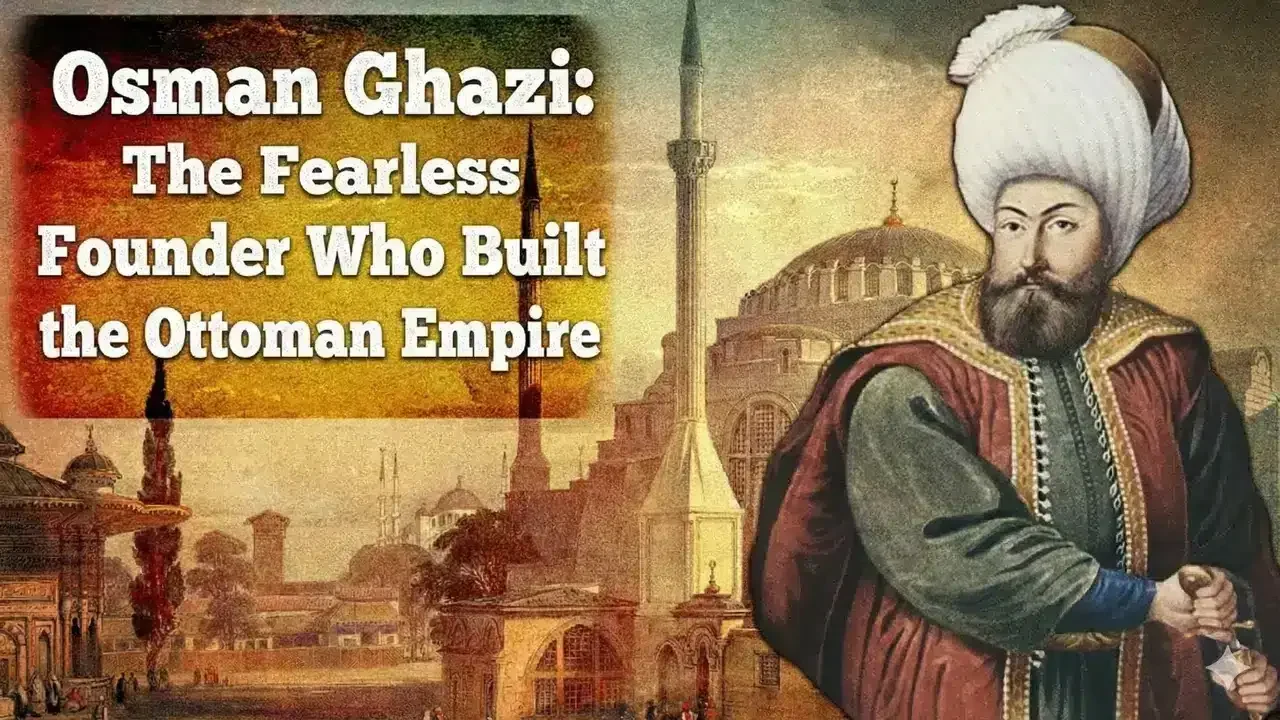
Osman Ghazi (Osman I) was the founder of the Ottoman Empire and the leader of the Kayi Tribe. Born in Sogut around 1258, he united the fractured Turkmen tribes of Anatolia into a formidable state. Through strategic marriages, religious alliances with the Ahi Brotherhood, and military brilliance at the Battle of Bapheus, he laid the groundwork for an empire that would rule three continents for over six centuries.
Check Also: Mehmed II: The Life and Legacy of the Sultan Who Conquered Constantinople
Introduction: The Spark That Ignited an Empire
In the late 13th century, the map of Anatolia was a fragmented mosaic of warring states. The once-great Seljuk Empire was crumbling under the iron fist of the Ilkhanid Mongols, while the Byzantine Empire in the West was slowly decaying. Amidst this chaos, a new power was rising on the frontier.
That power was Osman Ghazi. He was not just a tribal chieftain; he was a visionary statesman. unlike his contemporaries who were satisfied with raiding, Osman sought to build a permanent state based on justice (Adalet) and Islamic tradition. His life story is a fascinating blend of historical fact and enduring legend, marking him as one of the most significant figures in Islamic history.
The Lineage of Wolves: From Ertugrul to Osman
To understand Osman, one must understand his roots. He was the youngest son of Ertugrul Ghazi, the legendary leader of the Kayi Tribe, and Halime Hatun.
Under Ertugrul, the Kayi tribe had settled in Sogut as the guardians of the Seljuk frontier. When Ertugrul passed away around 1281, a power struggle ensued. However, Osman’s charisma and military prowess won over the tribal elders. He inherited not a kingdom, but a tent and a dream. He transformed the Kayi Tribe from nomadic herders into a disciplined military force capable of challenging imperial armies.
The Dream of Osman: A Divine Prophecy
History and folklore often intertwine in the Ottoman narrative. The most famous account is the “Dream of Osman.”
While staying at the dergah of the holy scholar Sheikh Edebali, Osman dreamt of a moon rising from the Sheikh’s chest and sinking into his own. Immediately, a colossal tree sprouted from his navel. Its shade covered the world, and rivers like the Tigris and Euphrates flowed from its roots.
Sheikh Edebali interpreted this as a divine sign:
“Osman, my son, you are destined for greatness. You and your descendants will rule the world, and my daughter shall be your wife.”
This prophecy did more than just boost morale; it secured the backing of the powerful Ahi Brotherhood, a socio-religious organization that provided Osman with the political legitimacy and manpower he needed to expand.
Military Genius: The Conquest of Anatolia
Osman Ghazi was a master tactician. He realized that fighting fellow Muslim tribes would only weaken the cause. Instead, he turned his gaze West—towards the Byzantine Empire.
The Conquest of Karacahisar
His first major move was against the fortress of Karacahisar. Upon conquering it, Osman showed his intent to build a state, not just loot. He appointed a Qadi (Judge) to administer justice and allowed the local Christian population to live in peace, paying a tax in exchange for protection. This policy of tolerance won him the loyalty of many locals.
The Battle of Bapheus (Koyunhisar): The Turning Point
The year 1302 marks the true historical beginning of the Ottoman state. Alarmed by Osman’s growing influence, the Byzantine Emperor sent a professional army to crush him. The two forces met at the Battle of Bapheus near Nicomedia.
Against the odds, Osman’s light cavalry outmaneuvered the heavy Byzantine infantry. This victory was earth-shattering. It signaled to the world that the Ottomans were no longer just a tribe; they were an independent power. Following this, Ghazis (warriors) from all over Anatolia flocked to Sogut to fight under Osman’s banner.
Check Also: Vlad the Impaler: The Real Brutal History Behind the Dracula Legend
The Siege of Bursa and The Final Days
The ultimate goal for Osman Ghazi was the capture of Bursa. This city was a key Silk Road hub and a gateway to Europe.
Osman encircled the city, building forts to cut off its supplies. However, the siege dragged on for years. During this time, Osman’s health deteriorated due to gout. Unable to ride into battle, he passed the command to his capable son, Orhan Ghazi.
In 1326, news arrived that Bursa had finally surrendered. Osman Ghazi died shortly after, but he died with a heart full of peace, knowing his son had secured the new capital of his budding empire.
The Legacy Continues: Orhan Ghazi and the Screen Adaptation
The torch passed from Osman to Orhan, who would go on to create the Janissaries and cross into Europe. The struggles, the battles, and the emotional depth of this era are brilliantly captured in modern media.
Currently, the saga of the Ottoman foundation continues with the series centered on Sultan Orhan Ghazi. It visualizes the transition of power and the expansion of the state. For international fans who want to witness this history unfolds, you can watch the series with English subtitles by visiting kurulusorhan.io. This platform offers an immersive experience into the life of Osman’s successor.
Timeline of Osman Ghazi’s Life
- 1258: Birth of Osman Ghazi in Sogut.
- 1281: Death of Ertugrul Ghazi; Osman becomes Bey of the Kayi Tribe.
- 1299: Traditional date cited for the declaration of independence of the Ottoman State.
- 1302: Historic victory at the Battle of Bapheus against Byzantines.
- 1326: Surrender of Bursa; Death of Osman Ghazi.
Check Also: Kingdom of Pontus Explained: Legends, Battles & Historical Impact
People Also Ask (FAQs)
1. Why is he called “Ghazi”?
The title Ghazi refers to a warrior who fights for the cause of Islam and justice. Osman earned this through his lifelong dedication to expanding the frontiers of the state and protecting his people from oppression.
2. Where is Osman Ghazi buried?
Osman Ghazi is buried in Bursa, Turkey. His tomb is located within the Silver Dome (Gümüşlü Kümbet), a former Byzantine chapel, fulfilling his final wish to lie in the city he spent years conquering.
3. Did Osman Ghazi fight the Mongols?
While the Seljuks engaged in devastating wars with the Mongols, Osman I adopted a strategy of avoiding direct conflict with the Ilkhanids. He focused his expansion westward against the weaker Byzantines, which allowed his state to survive while others perished.
4. Who were Osman Ghazi’s wives?
Historical records primarily mention two wives: Malhun Hatun, a noblewoman, and Rabia Bala Hatun, the daughter of his spiritual mentor Sheikh Edebali.