
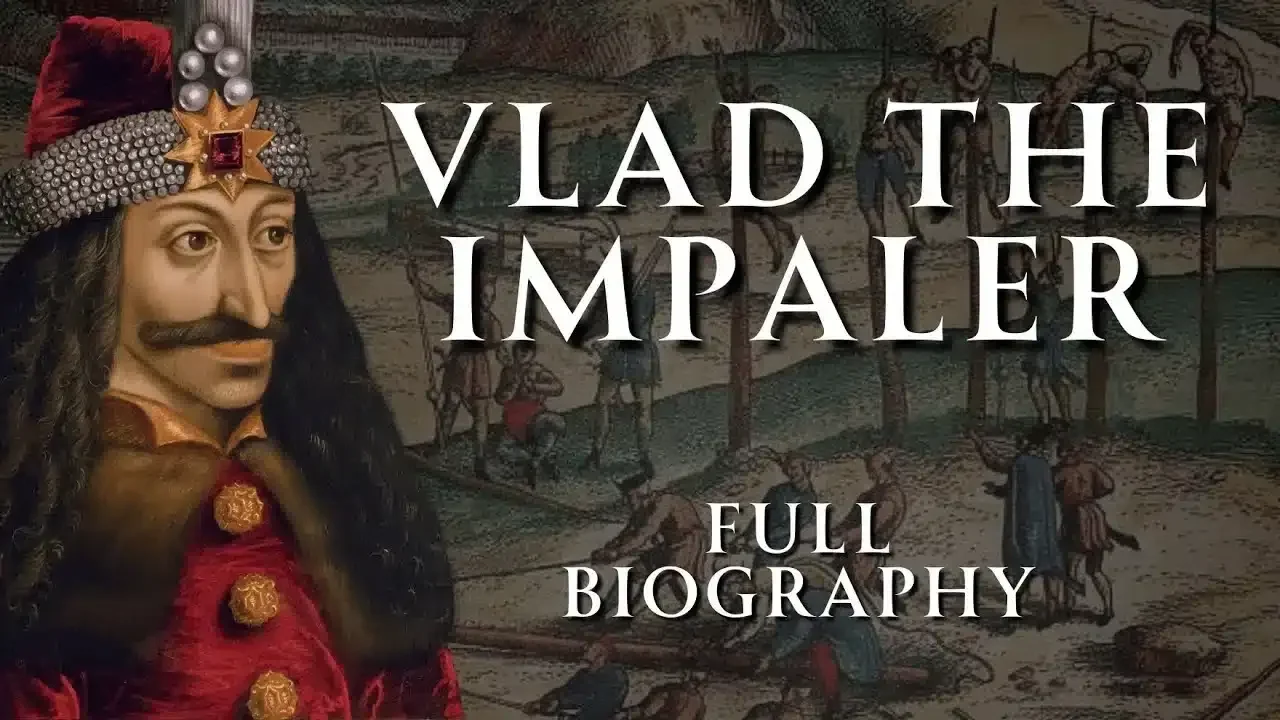
Vlad III, commonly known as Vlad the Impaler, was the 15th-century ruler of Wallachia (modern Romania). He is famous for his ruthless defense against the Ottoman Empire and his preferred method of execution: impalement. His terrifying reputation and war against Sultan Mehmed II inspired Bram Stoker’s fictional character, Dracula.
Check Also: Orhan Gazi: The Iconic Sultan Who Built a Legendary Empire
Introduction: The Man Behind the Monster
When people hear the name Dracula, they usually think of a vampire with sharp fangs, a black cape, and a thirst for blood. But the real story behind the legend is not about magic. It is about a human being who was far more dangerous than any fictional monster.
His real name was Vlad III, the Prince of Wallachia. History remembers him by a name that still sends chills down the spine: Vlad the Impaler (Vlad Țepeș).
He lived in the 1400s, a bloody time when kingdoms rose and fell through war. Vlad ruled with steel and fear. He killed thousands of people to protect his land from enemies inside and outside his borders. While the Western world views him as a villain, many people in Romania see him as a hero who defended his country against the massive Ottoman Empire.
To understand him, we must look at his childhood, his rise to power, and the brutal war that made him a legend.
The Meaning of “Dracula”
Where did the name Dracula come from? It was not a spooky nickname made up by a writer. It was his family name.
Vlad was born in 1431 in Transylvania, a land of mountains and forests. His father, Vlad II Dracul, was a member of the Order of the Dragon. This was a special group of knights promised to defend Europe from enemies.
In the Romanian language, “Dracul” meant “The Dragon.” Adding “a” at the end meant “Son of.” So, Dracula literally means “Son of the Dragon.”
However, there is a twist. In modern Romanian, “Dracul” also means “The Devil.” This double meaning fits Vlad perfectly. To his soldiers, he was a brave Dragon. To his enemies, he was the Devil himself.
Check Also: Kingdom of Pontus Explained: Legends, Battles & Historical Impact
A Childhood Held Hostage
Vlad did not have a normal childhood playing with toys. When he was a young boy, his father had to make a hard deal to keep peace with the Ottoman Empire. He sent two of his sons—Vlad and his younger brother, Radu the Handsome—as hostages to the Ottoman Sultan.
For years, Vlad lived in the city of Edirne. He was a prisoner, but he lived in the palace. During this time, he learned many things that would help him later:
- He learned the Turkish language perfectly.
- He studied the Art of War.
- He watched the Janissaries (elite soldiers) train.
This experience changed him. While his brother Radu became friends with the Sultan’s son (the future Mehmed II), Vlad grew to hate the Ottomans. He felt humiliated. He promised himself that one day, he would use everything he learned to destroy them.
Rise to Power: Cleaning Up Wallachia
When Vlad finally returned to Wallachia in 1456, his country was falling apart. The local nobles, called Boyars, were corrupt. They had killed Vlad’s father and brother. They thought they could control Vlad too.
They were wrong.
The Easter Feast Massacre
Vlad invited hundreds of these nobles to a big Easter feast at his castle. They ate, drank, and celebrated, thinking they were safe. Then, Vlad asked them a question: “How many princes have you lived to see?”
Some nobles said 10, others said 20. This proved they were traitors who switched sides constantly. Vlad’s soldiers surrounded the room. He took the older nobles and impaled them on the spot. He took the younger, stronger nobles and forced them to march 50 miles up a mountain. He made them build his fortress, Poenari Castle, until their clothes fell off and they died of exhaustion.
This brutal act sent a clear message: Wallachia had a new master, and he did not tolerate treason.
Check Also: Byzantine Empire: Statecraft, Law & Decline (330–1453) – The Legacy of Basileia Rhōmaiōn
Why Impalement? The Psychology of Fear
Vlad is famous for impalement, a horrific way to die where a wooden stake is driven through the body. But why did he choose this? Was he just crazy?
Historians believe it was psychological warfare. Vlad had a very small army. His enemies had huge armies. He could not win a fair fight. He needed to create absolute terror.
- To stop crime: Legends say Vlad hated thieves. During his rule, you could leave a golden cup in the middle of the road, and no one would steal it because they were too afraid of Vlad.
- To scare invaders: When enemy soldiers saw what happened to prisoners, they became too scared to fight.
The War of Brothers: Vlad vs. Radu
One of the saddest parts of Vlad’s life was his relationship with his brother, Radu the Handsome. Radu had stayed with the Ottomans. He converted to Islam and became a general for Sultan Mehmed II.
When the war started, it wasn’t just Vlad against the Sultan. It was brother against brother. Radu led Ottoman soldiers against Vlad’s Wallachian soldiers. Radu used kindness to win over the people, while Vlad used fear. In the end, the people chose Radu, and Vlad was betrayed by his own blood.
The Clash of Titans: Vlad III vs. Sultan Mehmed II
The biggest war of Vlad’s life was against Sultan Mehmed II (Mehmed the Conqueror). Mehmed was the powerful leader who had conquered Constantinople.
The war started over taxes. When Ottoman messengers came to ask for money, they refused to take off their turbans in front of Vlad. Vlad said, “I will help you keep them on forever,” and nailed the turbans to their heads. This insult started a massive war. Mehmed marched to Wallachia with over 100,000 soldiers.
Note for History Fans: This intense rivalry between Vlad and Mehmed is currently being shown on TV. You can watch the full story unfold in the series Mehmed: Fetihler Sultanı. To stream the episodes with English subtitles, visit kurulusorhan.io. Seeing the battles on screen helps you understand how intense this history really was.
The Night Attack at Târgoviște
Vlad knew he could not win a direct battle. He had only 30,000 men. So, he used guerrilla tactics. He burned his own villages so the Ottomans would have no food. He poisoned the water wells.
Then, on the night of June 17, 1462, he launched the Night Attack. Vlad dressed in Ottoman armor. He led his best soldiers into the enemy camp at midnight. They killed thousands of confused soldiers. Vlad’s goal was to find the Sultan’s tent and kill him, but he missed. Even though the Sultan survived, the attack caused panic and proved Vlad was a genius general.
The Forest of the Impaled
The war ended with one of the scariest sights in history. When Mehmed II marched his army to Vlad’s capital city, Târgoviște, he found the gates open. But outside the city, there was a “forest” of dead bodies.
Vlad had impaled 20,000 Ottoman prisoners on tall stakes. The smell was terrible, and the birds were eating the bodies. When the Sultan saw this, he was shocked. History books say he stated: “I cannot take the land of a man who does such terrible things to defend his kingdom.” Sickened by the sight, the Sultan turned his massive army around and went home. Vlad had won the battle using pure fear.
Death and Mystery
Vlad’s victory did not last. His brother Radu eventually took the throne with Ottoman help. Vlad was put in prison in Hungary for 12 years. He returned to Wallachia in 1476 for one last attempt to rule. But two months later, he was killed in battle.
What happened to his body? To prove he was dead, his head was cut off and sent to Constantinople preserved in a jar of honey. His body is said to be buried at Snagov Monastery, on an island near Bucharest. However, when archaeologists opened the grave in the 1930s, they found only horse bones. To this day, no one knows exactly where the real Dracula rests.
Timeline of Vlad the Impaler
- 1431: Born in Sighișoara, Transylvania.
- 1442: Sent as a hostage to the Ottoman Empire.
- 1456: Becomes ruler of Wallachia; executes the corrupt Boyars.
- 1462: The Night Attack against Sultan Mehmed II.
- 1462: Betrayed by his brother Radu and imprisoned.
- 1476: Dies in battle; his head is sent to the Sultan.
People Also Ask (FAQs)
Q: Was Vlad the Impaler actually a vampire?
A: No. Vlad was a human ruler. The vampire myth was created by author Bram Stoker in 1897, who used Vlad’s nickname “Dracula” for his character.
Q: How many people did Vlad kill?
A: Historians estimate Vlad was responsible for the deaths of about 80,000 people. This includes enemies in war and criminals he executed.
Q: Did Vlad the Impaler defeat the Ottoman Empire?
A: He won several battles, including the Night Attack, and forced Mehmed II to retreat once. However, Wallachia eventually fell under Ottoman control again.
Q: Where can I watch the series about Vlad and Mehmed?
A: The historical events are portrayed in the series Mehmed: Fetihler Sultanı. You can watch it with English subtitles at kurulusorhan.io.