
server 2:
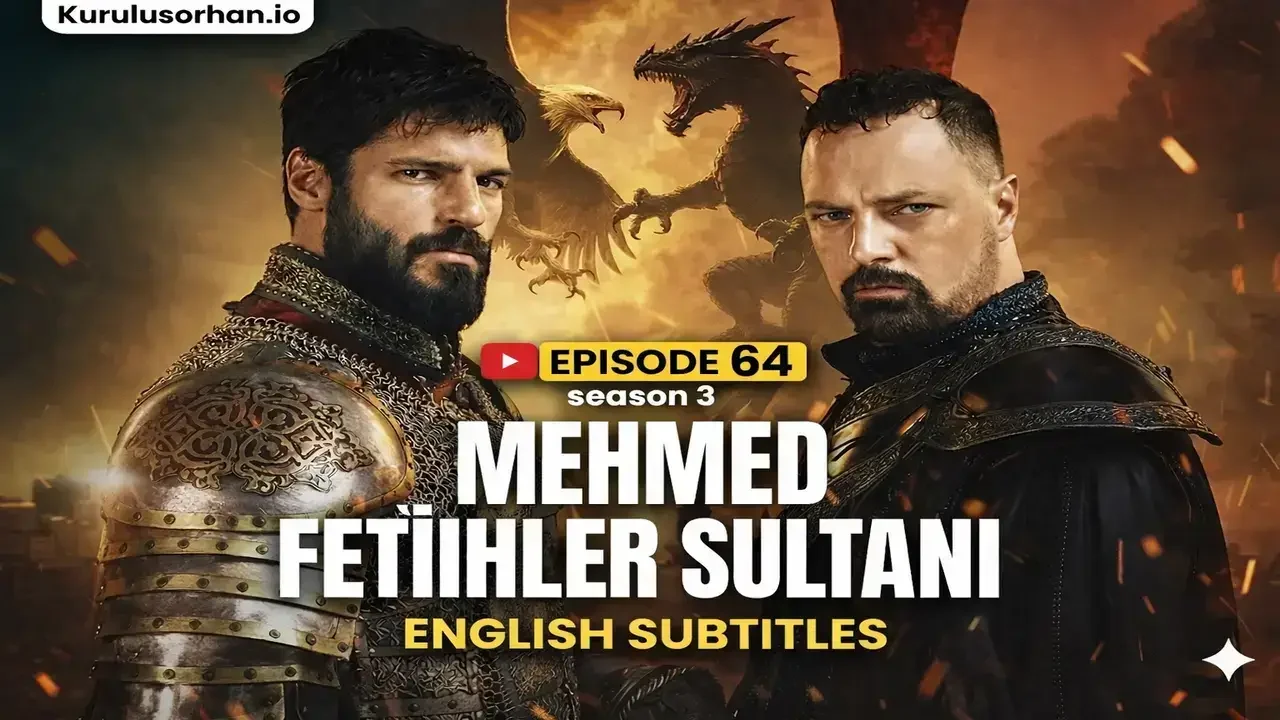
Mehmed Fetihler Sultanı Episode 64 deepens the moral and political weight of power as Sultan Mehmed confronts betrayal, religious manipulation, and state justice—revealing how conquest reshapes both enemies and rulers in the aftermath of Episode 63.
Check Also: Mehmed Fetihler Sultanı Episode 63 full review – for narrative continuity
Episode 64 Review: A Chapter About Control, Not Conquest
Mehmed Fetihler Sultanı Episode 64 is not an episode of expansion. It is an episode of containment—of enemies, of allies, and even of emotion. Where earlier chapters glorified momentum, this one slows the narrative to examine how authority is maintained once victory has already been achieved.
The episode draws its strength from restraint. Battles take a back seat to decisions, and decisions carry heavier consequences than swords.
Sultan Mehmed’s Justice: Mercy as a Weapon
At the heart of Episode 64 lies Sultan Mehmed Han’s philosophy of justice. His confrontation with David Komnenos, the last heir of a fallen dynasty, is not about vengeance. It is about moral hierarchy.
By sparing Komnenos while stripping him of power, Mehmed demonstrates a principle repeated throughout the episode:
punishment is more effective when it forces understanding, not silence.
This moment reinforces Mehmed’s portrayal not as a tyrant, but as a ruler who believes legitimacy comes from law, order, and clarity, not rage.
Vlad Tepeş: Madness, Punishment, and Political Containment
The handling of Vlad Tepeş is one of Episode 64’s most chilling elements. Rather than execution, Mehmed chooses confinement and degradation—a sentence rooted in both Islamic jurisprudence and state pragmatism.
By declaring Vlad unfit to rule and removing him from power without martyrdom, the episode highlights a recurring theme:
a dangerous man is more useful broken than dead.
This choice reframes cruelty as governance. Vlad’s punishment is not spectacle—it is strategy.
Check Also: Who was Vlad Tepeş in Ottoman history? – historical background
Bosna and the Religious Fault Line
Episode 64 devotes significant time to Bosna, presenting it not merely as a territory, but as a religious pressure point. The tension between Bogomils and Catholics, amplified by the influence of the Vatican, is shown as a weaponized divide.
Rather than simplifying the conflict, the episode carefully presents:
- forced taxation,
- religious hypocrisy,
- economic exploitation under faith-based justification.
This is where the episode achieves historical realism. Religion is not shown as belief alone—but as administration, control, and fear.
Stefan Tomašević: Loyalty as a Bargaining Chip
The portrayal of Stefan Tomašević, King of Bosna, avoids caricature. He is neither heroic nor foolish. Instead, he is depicted as a ruler caught between:
- Papal pressure,
- Ottoman authority,
- internal unrest.
Episode 64 positions him as a mirror to Mehmed—someone who wants sovereignty but lacks the institutional strength to enforce it without external backing. This contrast subtly reinforces why Mehmed’s rule succeeds where others fracture.
Kızılelma Reframed: Ideology Over Territory
Unlike earlier episodes where Kızılelma symbolized conquest, Episode 64 reframes it as responsibility. Mehmed’s speeches emphasize that victory without justice leads to decay.
The message is clear:
a state that expands faster than it governs collapses inward.
This ideological shift marks Mehmed Fetihler Sultanı Episode 64 as a philosophical episode—one that asks whether power can remain moral once it becomes absolute.
Social Justice and the Market Scenes
One of the episode’s most understated yet powerful segments takes place not in palaces, but in markets and villages. Through disputes over rent, grain, and taxation, Mehmed Fetihler Sultanı Episode 64 grounds empire-building in everyday suffering.
These scenes reinforce the Ottoman model presented in the series:
law exists to protect the weak, not reward the powerful.
Emotional Core: Memory, Family, and Legacy
Mehmed Fetihler Sultanı Episode 64 slows down to explore memory—particularly through scenes involving elders, children, and lineage. These moments humanize the cost of empire.
The emphasis on legacy answers a quiet question:
what survives after conquest—land, or values?
By the episode’s end, it is clear that Mehmed’s greatest concern is not borders, but continuity.
Timeline Context
- Episode 63: Power realignment, escape, and rising ideological threats
- Episode 64: Legal authority, religious pressure, and moral governance
Mehmed Fetihler Sultanı Episode 64 Release Information
Mehmed Fetihler Sultanı Episode 64 airs on TRT 1 on January 6, 2025. English subtitles are expected to follow within a few hours on kurulusorhan.io, subject to upload availability.
People Also Ask (FAQs)
Is Mehmed Fetihler Sultanı Episode 64 a battle-heavy episode?
No. Episode 64 focuses on political decisions, justice, and ideological conflict rather than large-scale battles.
Why does Sultan Mehmed spare his enemies?
The episode shows mercy as a form of control—forcing submission, understanding, and long-term stability.
What role does Bosna play in Episode 64?
Bosna represents religious and political fragmentation, highlighting how faith can be exploited for power.