
Introduction
The Kingdom of Pontus remains one of the most remarkable powers of ancient and medieval Anatolia. Rising from the rugged Black Sea mountains, the kingdom produced legendary rulers like Mithridates VI Eupator, challenged the mighty Roman Republic, and later survived through the medieval period as the Empire of Trebizond — until it finally fell to Sultan Mehmed II (Fatih Sultan Mehmed) in 1461.
Table of Contents
ToggleWatch the Sultan Mehmed II’s epic journey in our drama series section and relive the conquest of Pontus in full detail.
This article explores the origins, legends, major battles, cultural influence, and historic conquests that shaped the legacy of Pontus across two millennia.
Origins of the Kingdom of Pontus
The Kingdom of Pontus was founded in the 3rd century BCE along the southern shores of the Black Sea, in today’s northeastern Turkey. Its early rulers combined:
- Persian royal traditions
- Greek coastal city culture
- Indigenous Anatolian customs
This unique blend turned Pontus into a multicultural, militarily capable kingdom.
Mithridates VI Eupator: The Greatest King of Pontus
The most iconic ruler of Pontus was Mithridates VI Eupator, known as Mithridates the Great. His legend dominated ancient history due to:
- His strategic military genius
- Mastery of over 20 languages
- His anti-Roman stance
- The famous “poison immunity” story
Under Mithridates, Pontus expanded into a regional empire stretching across:
- Northern Anatolia
- Crimea
- Black Sea coastline
He became Rome’s greatest adversary.
The Mithridatic Wars: Pontus vs Rome
Pontus reached global attention through its epic conflicts with the Roman Republic.
First Mithridatic War (89–85 BCE)
Mithridates’ rapid conquest of Asia Minor stunned Rome. His support from local populations turned him into a regional hero.
Second Mithridatic War (83–81 BCE)
A short but intense conflict that exposed the continuous tension between Rome and Pontus.
Third Mithridatic War (75–63 BCE)
Led by Roman generals Lucullus and Pompey, this war marked the decline of Pontus. Despite exceptional strategy, Mithridates’ resources weakened. His dramatic flight to Crimea added to his larger-than-life legend.
The fall of Mithridates ended ancient Pontus, but the region’s identity survived.
The Empire of Trebizond: The Last Echo of Pontus
After Rome absorbed Pontus, centuries later a new Pontic state emerged: the Empire of Trebizond (1204–1461).
This empire was formed by the Komnenos dynasty after the Fourth Crusade fractured the Byzantine Empire.
Although smaller than ancient Pontus, Trebizond maintained:
- Greek-Pontic culture
- Independent trade routes
- Strong fortification along Trabzon
- Political diplomacy with Turks, Persians, and Mongols
It became the last surviving Byzantine successor state.
Sultan Mehmed II and the Final Conquest of Pontus (1461)
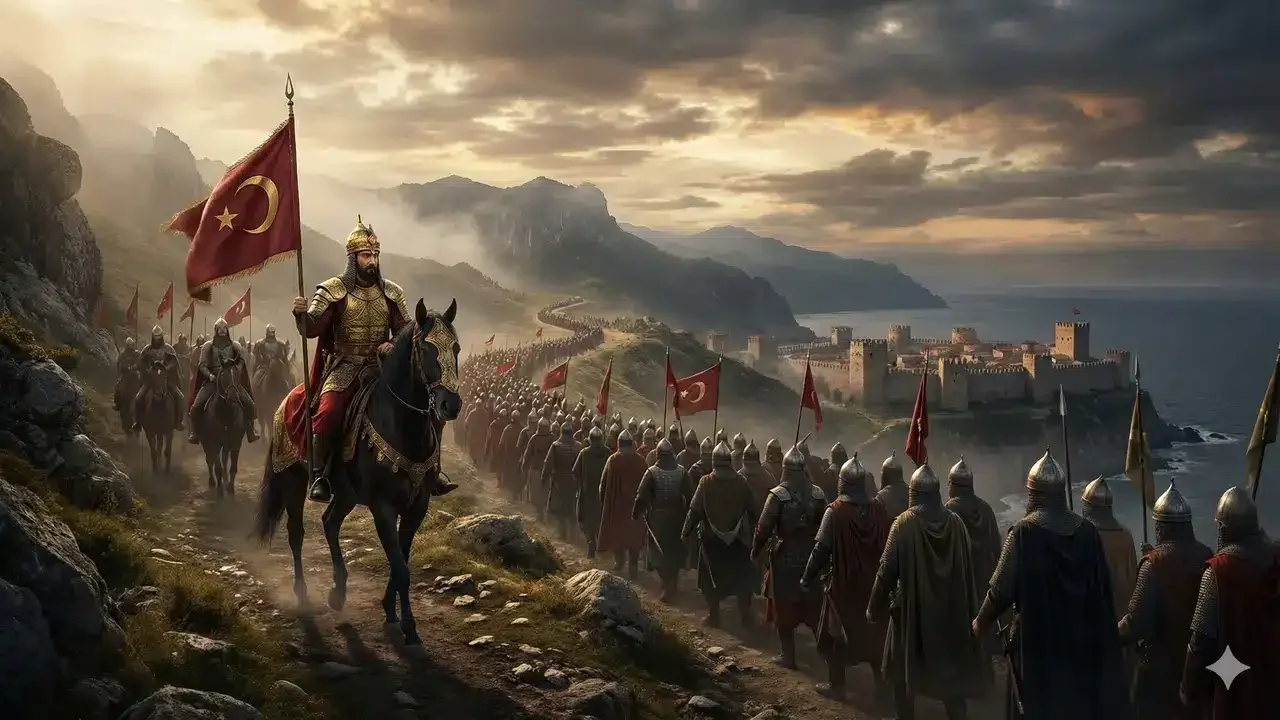
The final chapter of Pontic history arrived with Sultan Mehmed II, famously known as Fatih Sultan Mehmed, the Conqueror of Constantinople.
After taking Constantinople in 1453, Sultan Mehmed II aimed to unite all former Byzantine territories. The Empire of Trebizond, ruled by Emperor David Komnenos, stood as the last independent Greek state.
The Campaign of 1461
- Sultan Mehmed II marched through Amasya, Tokat, Gümüşhane, and the Pontic mountains.
- His naval forces blockaded Trebizond from the sea.
- After weeks of pressure, Trabzon surrendered peacefully on 15 August 1461.
Historical Significance
- It marked the final end of any Pontic or Byzantine political power.
- The region was incorporated into the Ottoman Empire.
- Pontic culture survived in language, traditions, and local heritage under Ottoman administration.
With this, Sultan Mehmed II closed the last chapter of the Kingdom/Empire of Pontus after almost 1,700 years of historical presence.
Culture, Economy & Society of Pontus
Cultural Fusion
Pontus blended Persian royal styles with Greek artistic sophistication.
Cities like Amasya, Sinope, and Trebizond became centers of poetry, philosophy, and trade.
Economic Strength
Pontus thrived on:
- Black Sea maritime trade
- Agriculture
- Timber and metals
- Silk road connections
Even during Trebizond’s era, the region was a key stop for traders from Persia, Central Asia, and Europe.
Military Legacy of Pontus
The Pontic army included:
- Scythian horse archers
- Persian-style infantry
- Greek hoplites
- Black Sea naval fleets
This diversity allowed Pontus to resist major empires like Rome and survive invasions for centuries.
Historical Impact & Lasting Legacy
The story of Pontus spans three major eras:
- Ancient Kingdom of Pontus under the Mithridatids
- Roman-Pontic provinces
- Empire of Trebizond, conquered by Sultan Mehmed II
Pontus remains important because:
- Mithridates VI is remembered as one of the greatest anti-imperial leaders
- Trebizond’s fall marked the final end of Byzantine power
- Pontic culture continues in language, music, and regional heritage
The name Pontus still evokes stories of resistance, culture, and strategic brilliance.
Conclusion
From the rise of Mithridates the Great to the final conquest by Sultan Mehmed II in 1461, the history of Pontus spans a rich and dramatic timeline. It is a tale of courage, cultural fusion, epic battles, and the endurance of identity.
The Kingdom of Pontus may have vanished from political maps, but its legacy remains deeply rooted in the history of Anatolia and the Black Sea world.